



















How Many Innings in Baseball? A Complete Guide for Every Level

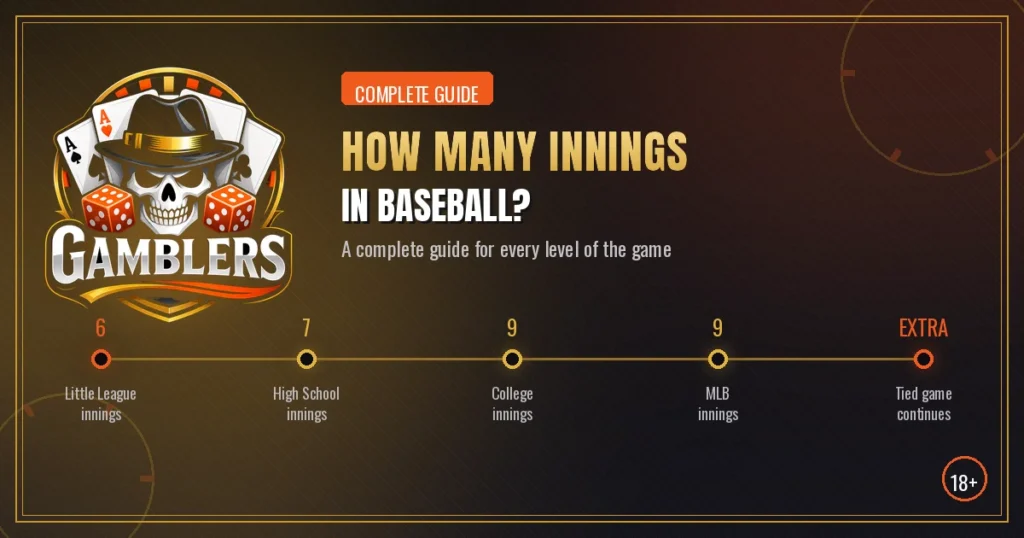
A standard baseball game has nine innings. That’s the number you’ll hear at every MLB field, on every broadcast, and in every rulebook for professional and adult amateur baseball. But that single number doesn’t tell the whole story. Little League games run six innings. High school games run seven. And if the score is tied after the regulation innings, the game doesn’t end. It continues continuing.
This article breaks exactly how many innings are in a baseball game at every level, what happens during an inning, why games occasionally grow shorter or longer, and which game holds the record for the most innings ever played.
What Is an Inning Exactly?
An inning is the basic building piece of a baseball game. Each inning contains two halves: the top and the bottom.
- Top of the inning: The visiting team bats. The home team plays defense.
- Bottom of the inning: The home team bats. The visiting team plays defense.
Each half-inning concludes after the defense registers three outs. So a whole inning equals six outs total, three for each side. Outs come from strikeouts, ground balls, fly balls, or any play where a batter or runner is retired before reaching base safely.
There’s one exception worth knowing. If the host side is already ahead after the top of the last inning, the bottom half doesn’t get played. There’s no sense to bat when the game is already decided, so the umpires call the game right there.
How Many Innings Are in a Baseball Game? (MLB)
In Major League Baseball, a regulation game is nine innings. This has been the standard since the earliest days of professional baseball, and it applies to every MLB game during the regular season and playoffs.
A few things to know regarding MLB’s nine-inning structure:
- If the score is tied after nine innings, the game proceeds into extra innings. Play continues until one side is ahead at the completion of a full inning.
- Since the 2020 season, MLB starts each extra inning with a runner already placed on second base during the regular season. This rule speeds up extra-inning games by making it simpler to score. It does not apply in the postseason, as extra innings are played the regular style, with the bases empty.
- A game can be deemed “official” before nine innings are complete if weather or another circumstance causes a stoppage. Once the visiting team has made 15 outs (five full innings) and the home team is leading, or once the home team has made 15 outs regardless of the score, the game counts as official if it has to be stopped.
- 2026 brings a new wrinkle to MLB games with the ABS question system, which lets a batter, pitcher, or catcher question a ball-or-strike call using computerized tracking. Each team gets two challenges per game, and one more per extra inning if none remain, but this affects individual pitch calls, not the number of innings played.
How Many Innings in College Baseball?
College baseball, governed by the NCAA, also plays nine innings per game, matching the professional standard. The main structural difference in college ball shows up in scheduling rather than innings count: teams often play a mid-week single game plus a weekend series, and some conference doubleheaders use seven-inning games instead of nine, similar to what you’ll see in college softball.
If you’re watching an NCAA regional or the College World Series, expect the full nine innings, with extra innings played precisely like the pros: continuing until someone takes the lead at the completion of a complete frame.
Innings in Baseball at Other Levels
Not every level of the sport plays nine innings. Here’s how it breaks down:
| Level | Innings per Game |
| MLB (professional) | 9 |
| NCAA college baseball | 9 (7 in some doubleheader formats) |
| High school (most U.S. states) | 7 |
| Babe Ruth League (13-15 age group) | 7 |
| Little League Baseball (ages 9-12) | 6 |
| Little League Baseball (ages 4-8, coach-pitch) | Often shorter, time-limited |
| Softball (fastpitch, most levels) | 7 |
The shorter forms exist for a practical reason: younger players have less energy, shorter attention spans, and pitch-count limits designed to preserve developing arms. A 9-year-old pitcher throwing six innings a week already faces substantial physical demands; nine complete innings would push that too far.
Why Do Games Go Longer Than Nine Innings?
Extra innings exist because baseball, unlike most major sports, has no clock. A game can’t end in a tie under normal rules, so if the score is level after the regulation number of innings, teams keep playing until someone wins.
This is different from many international leagues. Nippon Professional Baseball (NPB) in Japan and the Chinese Professional Baseball League (CPBL) stop games at 12 innings before declaring a tie. The KBO League in South Korea instituted an 11-inning restriction on most games starting in 2025. MLB has no such cap; American professional games are, in theory, allowed to continue indefinitely until a winner emerges.
That “in theory” has generated some astonishing games.
How Many Innings in the Longest Baseball Game Ever Played?
The longest professional baseball game in history lasted 33 innings. It happened between the Pawtucket Red Sox and the Rochester Red Wings, two Triple-A teams, starting on April 18, 1981, at McCoy Stadium in Pawtucket, Rhode Island. The game got interrupted at 4:07 a.m. after 32 innings, with only 19 supporters left in the grandstand, and finished more than two months later on June 23. Total playing time across the whole thing ran around 8 hours and 25 minutes.
At the Major League level, the longest game by innings was 26 innings, contested between the Brooklyn Robins and the Boston Braves on May 1, 1920. It concluded in a tie, called on account of darkness, and astonishingly, it only took roughly 4 hours to play.
The longest completed MLB game with an actual winner ran 25 innings: the Chicago White Sox beat the Milwaukee Brewers in May 1984, with Harold Baines ending it on a home run in the bottom of the 25th. That game took 8 hours and 6 minutes split across two calendar days due to a league curfew requirement.
At the college level, the NCAA record belongs to a 2009 game between Texas and Boston College, which went 25 innings and lasted just over 7 hours.
Here’s a quick look at some of the most notable marathon games:
| Game | Innings | Year | Level |
| Pawtucket Red Sox vs. Rochester Red Wings | 33 | 1981 | Triple-A |
| Brooklyn Robins vs. Boston Braves | 26 | 1920 | MLB |
| White Sox vs. Brewers | 25 | 1984 | MLB |
| Cardinals vs. Mets | 25 | 1974 | MLB |
| Texas vs. Boston College | 25 | 2009 | NCAA |
Innings Pitched: A Related Stat Worth Understanding
If you’re getting into baseball metrics, you’ll stumble into “innings pitched” (IP), which indicates how many innings a pitcher has completed based on outs recorded while he’s on the mound. One out represents one-third of an inning, two outs equal two-thirds, and three outs form a full inning. That’s why you’ll sometimes see a stat line like 6.2, meaning six full innings plus two outs in the seventh.
Cy Young holds the all-time career record with 7,356 innings pitched, a number that will almost certainly never be touched given how modern pitching staffs rotate arms and limit workloads. Pitchers in the 1800s and early 1900s often threw 400 or more innings in a single season; today’s workhorse starters typically pitch anywhere between 180 and 220.
FAQs
Q1. How many innings are in a baseball game?
Nine for MLB, college and most adult leagues. Younger age groups have less: seven for high school and Babe Ruth League and six for Little League Baseball 9-12.
Q2. How many innings in college baseball?
Nine, same as pro baseball. Some doubleheader formats are played in seven-inning games at some levels.
Q3. Do all baseball games have nine innings?
No. Little league, some high school leagues and softball generally play fewer innings, usually six or seven, to accommodate the physical demands appropriate for the age of the players.
Q4. What happens if the score is tied after nine innings?
The game moves into extra innings and goes on until one side is ahead at the end of a completed inning or the host club scores the winning run in the middle of its turn at bat.
Q5. What are the most innings ever played in one game?
33 innings in a minor league game in 1981 between the Pawtucket Red Sox and the Rochester Red Wings. The record at the MLB level is 26 innings, set in 1920.
The Bottom Line
Nine innings is the number to remember for MLB and collegiate baseball, but baseball’s structure flexes depending on who’s playing. Little Leaguers play six, high schoolers play seven, and every level shares the same core idea: play continues until each team has had a fair turn on offense and defense and until someone actually wins. That flexibility, plus the total absence of a game clock, is exactly what made a 33-inning marathon possible in the first place and why baseball, unlike almost every other major sport, can never technically run out of time.